

The Leaf That Could Power a Nation

South Korean scientists have created an artificial leaf that turns sunlight and water into hydrogen — no wires, no grid, no emissions. For sun-drenched Indonesia, it may be a glimpse of the future.
Science & Energy Desk · May 2026 · 8 min read
eyesonindonesia
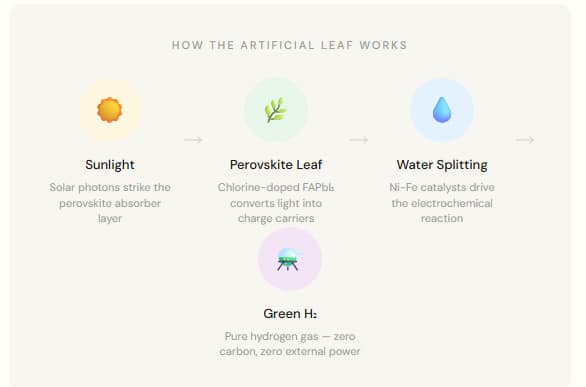
How the artificial leaf works
A Leaf Forged in a Laboratory
Nature figured it out billions of years ago: capture sunlight, split water, store energy. Every green leaf on earth is a miniature hydrogen factory, converting photons into chemical fuel with elegant simplicity. Now, scientists at the Ulsan National Institute of Science and Technology (UNIST) in South Korea have done something plants never managed — they’ve made the process efficient enough to matter.
Published in the May 2025 issue of Nature Communications, the research from professors Jae Sung Lee, Sang Il Seok, and Ji Wook Jang describes a modular artificial leaf that generates hydrogen directly from sunlight and water — no external electricity required, no carbon dioxide emitted. The team didn’t just build a curiosity for the laboratory. They built something that could scale.
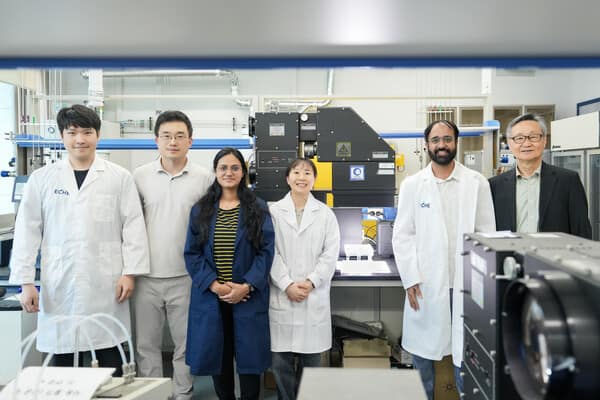
“The system mimics natural leaves by producing hydrogen solely from sunlight and water, without requiring external power sources or emitting carbon dioxide.”
The key to their success lies in material science. At the heart of the device is a chlorine-doped perovskite absorber — a synthetic crystalline compound that captures solar light with extraordinary efficiency. Paired with ultraviolet-resistant tin oxide transport layers and nickel-iron electrocatalysts, the photoelectrodes convert incoming photons into electron-hole pairs that drive the splitting of water into hydrogen and oxygen.
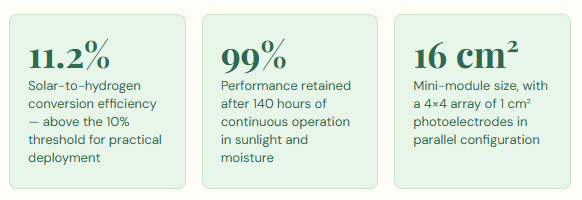
For years, the science of artificial photosynthesis has been plagued by a trilemma: any device could achieve high efficiency, or good stability, or scalable production — but rarely all three at once. UNIST’s team cracked all three simultaneously. The modules maintained 99% of their original performance after 140 hours of continuous exposure to sunlight and moisture, a durability milestone that previous systems had failed to reach. And crucially, the design can be assembled into large-area panel arrays, much like conventional solar installations.
Why this is different
Unlike conventional solar-plus-electrolysis systems — which convert sunlight to electricity, transmit it, then use that electricity to split water — the artificial leaf skips the electrical conversion step entirely. This eliminates energy losses at each transfer and reduces the physical footprint dramatically. Fewer components. Fewer failure points. Lower cost per kilogram of hydrogen produced.
The bigger picture
Chasing the Green Premium
The UNIST breakthrough arrives at a pivotal moment in the global hydrogen story. Green hydrogen — produced from renewable energy rather than fossil fuels — has long been heralded as the missing piece of the clean energy puzzle. It can decarbonize industries that electricity alone cannot easily reach: steel production, aviation, long-haul shipping, chemical manufacturing. But it has a stubborn problem: cost.
Conventional green hydrogen, produced by running renewable electricity through an electrolyzer, typically costs between $3 and $8 per kilogram to produce — far above the $1–2 per kilogram of fossil-derived grey hydrogen. Artificial photosynthesis, if it can be scaled efficiently, sidesteps much of the electrolyzer infrastructure and could bring those costs down significantly. The UNIST team’s 11.2% solar-to-hydrogen efficiency — above the 10% threshold generally considered necessary for practical application — suggests that the economic gap may finally be closeable.
The research was funded by South Korea’s Ministry of Science and ICT and the Institute for Basic Science, reflecting a national commitment to positioning Korea as a leader in the hydrogen economy. But the technology’s implications ripple far beyond the Korean peninsula.
Indonesia’s opportunity
An Archipelago Sitting on a Solar Fortune
Seventeen thousand islands straddling the equator. A coastline longer than the circumference of the Earth. And sunshine — relentless, year-round, equatorial sunshine — pouring down at intensities that most of the world can only dream of. Indonesia is, in the language of energy planners, extraordinarily well-endowed with renewable resources.
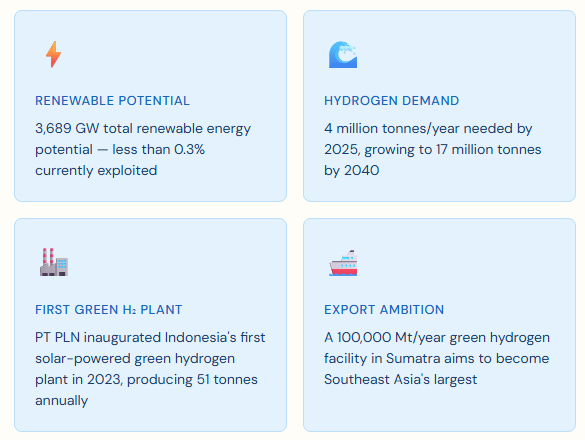
The numbers are staggering. Indonesia’s total renewable energy potential has been estimated at around 3,689 gigawatts — of which less than 0.3% has been developed. The country’s solar resource alone is assessed at 3,315 GWp of potential installed capacity. East Nusa Tenggara, in the east of the archipelago, achieves solar capacity factors of up to 18%, among the highest in Southeast Asia. For a technology powered entirely by sunlight, Indonesia is an almost ideal deployment environment.
Export Ambition
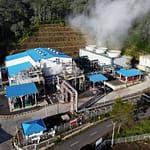
A 100,000 Mt/year green hydrogen facility in Sumatra aims to become Southeast Asia’s largest
Indonesia’s National Hydrogen Strategy, published in late 2023, laid out a three-phase roadmap. The current period through 2030 focuses on research, pilot projects, and regulatory groundwork. Between 2031 and 2035, the country plans to begin large-scale green hydrogen production. By 2060, Indonesia’s Ministry of Energy projects hydrogen demand of 9.9 million tonnes per year, spanning industry, transportation, power generation, and household gas networks.
“Indonesia could pivot from being a fossil fuel exporter to a leading producer and exporter of green hydrogen derivatives — green ammonia, green methanol, even green steel.”
The challenge, until now, has been bridging the gap between abundant solar resource and affordable hydrogen production. The standard pathway — solar panels, grid transmission, electrolyzer — requires substantial infrastructure, favors large centralized installations, and remains expensive. For a country of Indonesia’s geographic complexity, where remote islands and dispersed communities make grid extension prohibitively costly, that model has real limitations.
The fit
Why Artificial Leaves Could Thrive Here
This is where UNIST’s artificial leaf technology offers something qualitatively different. A modular system that needs only sunlight and water to produce hydrogen has an inherent advantage in archipelagic environments. It requires no transmission infrastructure. It can be deployed at small scale, close to demand, and expanded incrementally. For remote communities in Kalimantan, Papua, or the Lesser Sunda Islands — currently reliant on diesel generators — a distributed hydrogen production system could be transformative.
The technology’s modularity also aligns with Indonesia’s diverse renewable energy landscape. The best solar resources in East Nusa Tenggara are far from the main industrial centers on Java. Conventional hydrogen production from those sites would require either long-distance hydrogen pipelines — an enormous capital investment — or transportation by ship, with associated losses and costs. Distributed production, scaled to local needs, sidesteps these challenges entirely.
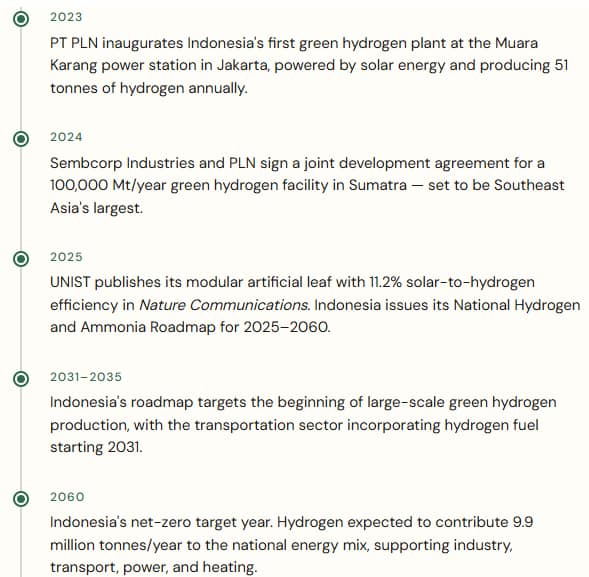
Indonesia’s net-zero target year. Hydrogen expected to contribute 9.9 million tonnes/year to the national energy mix, supporting industry, transport, power, and heating.
Indonesia’s government has signalled openness to investment and incentives for green hydrogen, including potential tax holidays and import duty exemptions for clean energy capital equipment. As the UNIST technology matures toward commercial deployment — likely within the next decade — Indonesia represents one of the world’s most compelling target markets: vast solar resources, enormous hydrogen demand, geographic complexity that rewards decentralization, and a government actively seeking the technology to achieve its 2060 net-zero commitment.
The road ahead
Artificial leaves are not yet commercial products. Moving from a 16 cm² laboratory module to panels that can supply meaningful quantities of hydrogen requires continued engineering advances in manufacturing, system integration, and cost reduction. But the UNIST team has cleared the most stubborn scientific barriers — efficiency above 10%, durability beyond 140 hours, and demonstrated scalability. The next chapter is industrial, not scientific.
Conclusion
Nature’s Blueprint, Reimagined
There is something deeply elegant about the artificial leaf. Billions of years of evolution produced the most efficient solar converter in history — and scientists spent decades trying to reverse-engineer it. Now, for the first time, a team in Ulsan, South Korea, has produced a device that meets the trifecta: efficient, durable, and scalable. That is not a small thing.
For Indonesia, the implications are profound. A country wrestling with the tension between its fossil fuel heritage and its clean energy ambitions now has a clearer technological path forward. The artificial leaf doesn’t require the vast infrastructure of conventional hydrogen production. It needs what Indonesia has in abundance: sun, water, and the political will to build something new.
The leaf — that ancient, ordinary miracle of photosynthesis — may yet become the engine of a green industrial revolution. And if it does, the archipelago nation straddling the equator, with its 17,000 sun-drenched islands and 270 million people, will be one of the best places on earth to watch it unfold.
Sources & Further Reading
UNIST artificial leaf research published in Nature Communications, May 6, 2025. Indonesia National Hydrogen Strategy, Ministry of Energy and Mineral Resources, 2023. Indonesia National Hydrogen and Ammonia Roadmap 2025–2060 (MEMR). International Solar Alliance – Green Hydrogen Innovation Centre country report: Indonesia. Chambers & Partners – Renewable Energy 2025: Indonesia.
Key Researchers
- Prof. Jae Sung Lee
- Prof. Sang Il Seok
- Prof. Ji Wook Jang
- School of Energy and Chemical Engineering, UNIST, Ulsan, South Korea