

Indonesia’s Innovation Frontier

How Europe Is Building Its Most Strategic Partnership in Southeast Asia
No direct equivalent of ENRICH in LAC exists for Indonesia — but what Brussels has assembled instead may be even more powerful: a multi-layered architecture of trade, research, and startup investment that is reshaping one of the world’s most dynamic economies.
eyesonindonesia
Standing before more than 200 scientists, university leaders, and EU diplomats in Jakarta last June, Prof. Ir. Togar Mangihut Simatupang set the tone with striking clarity. Indonesia’s Secretary General for Higher Education, Science, and Technology called Horizon Europe “a unique chance to collaborate internationally, access cutting-edge research facilities, and contribute to solutions that impact global challenges.” It was a statement that could have come from a European minister — which is precisely the point. The EU-Indonesia innovation relationship has quietly become one of the most consequential science-and-commerce bridges between Europe and the Indo-Pacific.
It doesn’t have a single catchy acronym like ENRICH in LAC. It doesn’t operate from one hub office. Instead, it works through an interlocking set of programmes, agreements, and ecosystems that, taken together, amount to something arguably more durable: a whole-of-relationship approach to innovation between two economies that together represent a combined market of over 735 million people.
The Closest Equivalent: ARISE+ Indonesia
The programme that most closely mirrors ENRICH in LAC’s mandate is ARISE+ Indonesia — the country-level arm of the EU’s ASEAN Regional Integration Support programme.
In 2018, Indonesia and the European Union signed a €10 million Financing Agreement for ARISE+ Indonesia, a major five-year programme aimed at improving Indonesia’s export competitiveness and integration in global value chains. The programme focused on four product categories with great export potential: agri-food, fish, wood-based products, and cosmetics.
The results were tangible and immediate. ARISE+ Indonesia provided opportunities and support to domestic industries including SMEs, enabling them to participate in international trade — with Indonesian MSMEs in textile products and halal food successfully entering six electronic markets in Spain, Hungary, France, and Germany. The programme also triggered better investment policy planning and increased the capacity of Indonesian stakeholders in analysing trade policies.
But ARISE+ went further than export matchmaking. Under its investment pillar, ARISE+ Indonesia supported the development of an EU-Indonesia Investment Attraction Plan and organised a study mission to Europe for Indonesian investment officials, facilitating connections between the Indonesian Investment Promotion Center and prospective EU companies. The plan envisioned a reactivated EU Desk at Indonesia’s Ministry of Investment, serving as a conduit linking sustainable projects with EU financing instruments including the Global Gateway and the European Fund for Sustainable Development Plus.
The Historic Game-Changer: EU-Indonesia CEPA
If ARISE+ laid the plumbing, then the EU-Indonesia Comprehensive Economic Partnership Agreement is the main water supply.
On 23 September 2025, the European Union and Indonesia concluded negotiations on a CEPA in Bali, finalising the text after nearly a decade of talks. The agreement eliminates tariffs on over 98% of tariff lines, effectively covering nearly all trade by value between the two economies.
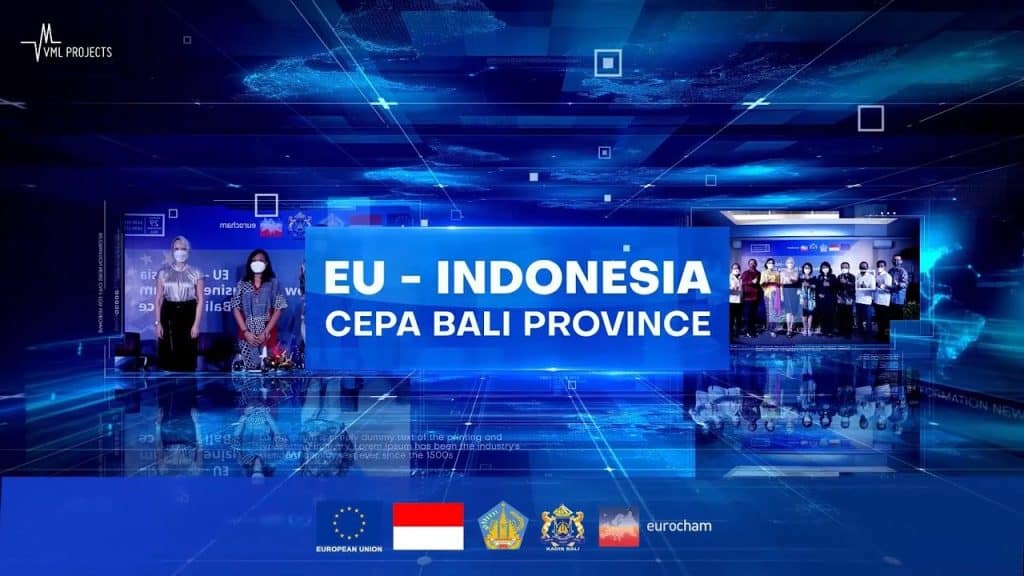
The scale of the opportunity this unlocks is hard to overstate. The deal positions itself within a growing economic partnership — €27.3 billion in goods trade in 2024, €8.8 billion in services trade in 2023, and €25.1 billion in EU investment stocks — and CEPA is expected to accelerate investment in strategic sectors like electric vehicles, electronics, and pharmaceuticals.
For the innovation and startup community specifically, the CEPA’s digital provisions matter most. The agreement strengthens digital trade rules, including protections for cross-border data flows and a ban on customs duties for electronic transmissions, and enhances transparency in government procurement. It also creates new opportunities for EU business and investors in green sectors by eliminating tariffs on green goods and improving the regulatory environment in areas such as renewable energy and electric vehicles.
EU Trade Commissioner Maroš Šefčovič, standing in Indonesia to mark the historic milestone, framed the agreement as something larger than a tariff schedule: “In today’s unpredictable global economy, trade relationships are not merely economic tools — they are strategic assets that signal trust, alignment, and resilience.”
Indonesian officials are targeting 1 January 2027 for entry into force, contingent on completion of ratification processes on both sides.
Horizon Europe: The Research Bridge
Alongside the trade architecture, the EU has been quietly building an equally significant scientific bridge through its flagship Horizon Europe research programme.
In June 2025, Indonesia’s Ministry of Higher Education, Science, and Technology co-hosted — with the EU Delegation and EURAXESS Worldwide for ASEAN — a major forum titled “EU-Indonesia: Strengthening Impactful Partnerships in Science and Technology” in Jakarta, bringing together more than 200 representatives from Indonesian universities, EU member state embassies, research institutes, and international cooperation agencies.
The forum featured in-depth discussions on the Horizon Europe Strategic Plan 2025–2027, funding mechanisms, EU missions, and successful EU-Indonesia project testimonials — including researchers who had participated in Research Innovation Actions and Marie Skłodowska-Curie Actions projects.
The MSCA programme is particularly significant for a country like Indonesia, which has an enormous pool of emerging scientific talent. It funds researcher mobility, allowing Indonesian scientists to work in European laboratories and vice versa — creating the person-to-person trust and knowledge transfer that no trade agreement can replicate.
Indonesia’s Startup Rocket: A Landscape Unlike Any Other
To understand why Europe is investing so heavily in building these bridges, one must understand what Indonesia’s startup ecosystem actually looks like from the inside.
The country’s digital economy is projected to exceed $130 billion by 2025, driven largely by e-commerce and fintech, according to a joint study by Google, Temasek, and Bain & Company. Indonesia’s vibrant digital ecosystem includes global tech players like Amazon, Google, Microsoft, Meta, and Apple, alongside major regional firms such as GoTo — the merged Gojek-Tokopedia entity — Shopee, and Lazada, increasingly investing in digital banking, logistics, and cloud services.
Indonesia currently counts 13 unicorn startups, spanning fintech, e-commerce, aquaculture technology, and logistics. The story of GoTo — formed from the 2021 merger of Gojek and Tokopedia — has become emblematic of the ecosystem’s ambition. The combined entity contributes approximately 2% of Indonesia’s GDP and was included multiple times in Fortune’s Change the World List alongside Microsoft, Accenture, and Apple.
Yet the ecosystem faces a reckoning. Several Indonesian unicorns have struggled to maintain their valuations in a tighter macroeconomic environment, as competition intensified and capital became scarcer — a cautionary tale about overhyped valuations and the fragile nature of tech success in emerging markets. It is precisely in this context that deeper structural partnerships with Europe — offering access to Horizon Europe co-funding, EU market entry, and the disciplined innovation methodology of programmes like Eurostars — become most valuable.
The Indonesian government is targeting the digital onboarding of more than 64 million micro, small and medium enterprises, with a goal of 30 million MSMEs going digital — encouraging them to ‘Go Digital and Go Global.’ European partners, with their deep experience in SME support infrastructure, are natural allies in that ambition.
The Global Gateway: Europe’s Grand Strategic Bet
Underlying all of these individual programmes is a single strategic vision: the EU’s Global Gateway initiative — Europe’s answer to China’s Belt and Road — which channels investment into digital, energy, and transport infrastructure in partner countries.
EU officials have explicitly framed the Indonesia Investment Attraction Plan as an illustration of the Global Gateway strategy in action — mobilising private sector investments and innovation towards Indonesia’s sustainable development goals. The plan envisions a flow of European capital into smart cities, urban mobility, renewable energy, healthcare, agribusiness, and the green economy — exactly the sectors where Indonesian startups are most active.
For Indonesia, whose government has set an ambition to become the world’s fifth-largest economy by 2045, this is not charity. It is a calculated strategic alignment. For Indonesia, CEPA promises stronger access to a premium consumer market and an upgraded regulatory environment that boosts investor confidence — anchoring its industrialisation to a high-standard market.
What Indonesia Needs That ENRICH in LAC Provides Elsewhere
The honest answer to whether there is a direct ENRICH in LAC equivalent for Indonesia is: not yet. ENRICH’s particular genius — a single network hub that physically brings together European and LAC innovation actors, certifies soft-landing providers, and maintains a living community of practice — does not have a precise Indonesian counterpart.
What exists instead is a mosaic: ARISE+ for trade facilitation, Horizon Europe for research, the EU-Indonesia CEPA for market access, the Global Gateway for infrastructure investment, and EURAXESS for researcher mobility. Each piece is powerful. What is missing is the connective tissue — a single point of entry for an Indonesian startup founder who wants to know how to soft-land in Amsterdam, or for a European deeptech company that wants to find an Indonesian research partner.

That gap is becoming visible to EU policymakers. As the CEPA moves toward ratification and the Horizon Europe Strategic Plan 2025–2027 deepens its engagement with Southeast Asian partners, the question of whether an ENRICH-style hub might eventually be established for the ASEAN region is likely to become a live policy conversation in Brussels.
A Partnership Ready for Its Next Chapter
The numbers tell one story: a €10 million ARISE+ investment, a €93.5 billion Horizon Europe programme, a CEPA that will save EU exporters €600 million a year in duties alone, and a digital economy growing toward $130 billion. But the more important story is about strategic positioning.
For Europe, the Indonesia relationship is a key part of its Indo-Pacific strategy and efforts to diversify supply chains — a world where geopolitics and climate policy are reshaping trade, and a finalised deal channels those forces constructively.
Indonesia, with its 280 million consumers, its 13 unicorns, its green hydrogen potential, its critical mineral wealth, and its young, mobile-first population, is not a frontier market to be cautiously explored. It is a core partner to be strategically embraced.
The bridges between Jakarta and Brussels are being built. The mortar is still setting. But the foundations — trade, research, investment, and innovation — are more solid than at any point in the history of this relationship.
What comes next is up to the entrepreneurs, scientists, and policymakers on both sides of the world who decide to walk across them.
The EU-Indonesia CEPA is currently undergoing legal and linguistic review ahead of ratification, with entry into force targeted for early 2027. The Horizon Europe programme for 2025–2027 remains open for participation by Indonesian research institutions.