

The Aluminum Archipelago

Why Indonesia Is Becoming the World’s Most Consequential Metals Bet — and at What Cost
eyesonindonesia
Jakarta / West Kalimantan / Sulawesi / Weda Bay — Ten years ago, Indonesia was a nickel backwater. Raw ore left its ports by the shipload, bound for Chinese smelters, enriching foreign processors while Indonesian miners dug the earth for a fraction of the metal’s true value. Then Jakarta pulled the lever. It banned nickel ore exports. Chinese capital flooded in. Smelters rose from jungle clearings. And Indonesia’s share of global nickel production rocketed from 7% to 60% in a single decade — the most dramatic resource transformation of the 21st century.
Now, Jakarta is pulling the same lever again. This time, the metal is aluminum. And the world’s investors — Chinese conglomerates above all, but also the global financial institutions tracking them — are paying very close attention.
“Indonesia’s combination of resources, reasonable power costs, and supportive policies creates a perfect storm for aluminum sector growth,” says industry analyst Andy Farida of Fastmarkets. The question is whether that storm can be channelled into prosperity without also sweeping away the forests, rivers, and communities that lie in its path.
The Lever: A Ban That Changed Everything
The story begins, as so many Indonesian industrial stories do, with a government decree that the rest of the world initially dismissed as bluster.
In June 2023, Indonesia officially banned bauxite ore exports, following a 2020 law requiring all raw minerals to be processed domestically before export. The policy mirrors the earlier nickel export ban introduced in 2020, part of Indonesia’s broader “downstreaming” industrialization program, now continued under President Prabowo Subianto.
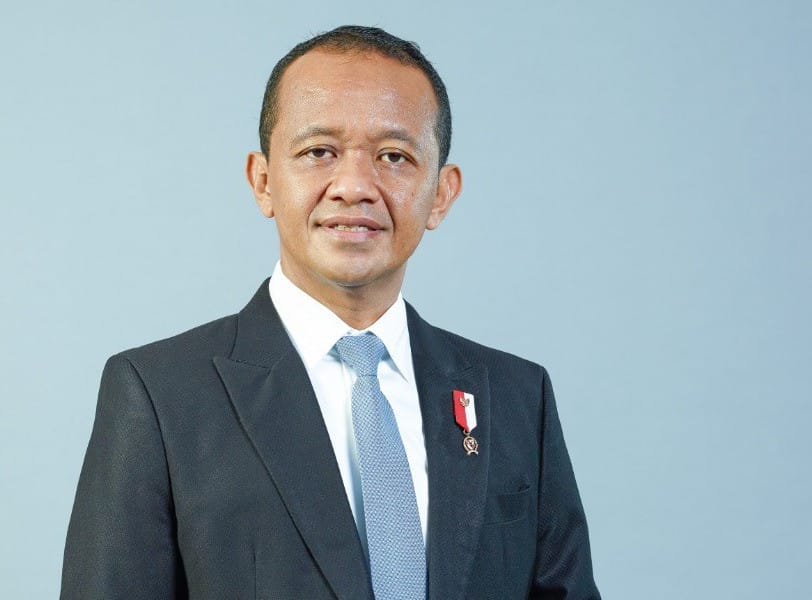
The logic was explicit and unapologetic. “We still import many bauxite derivatives like aluminum. Domestic demand is higher than industrial capacity, so we need investors to build bauxite smelters here,” Energy and Mineral Resources Minister Bahlil Lahadalia said in Jakarta. “Bauxite is one of the key commodities we’re prioritizing for downstream industrialization. That’s why we’ve banned its raw exports.”
The precedent for optimism was powerful. In the early years of nickel exports, Indonesia’s annual export value stood at just USD 1.1 billion. After banning nickel ore exports in January 2020, the export value of the nickel industry surged to USD 20.9 billion in 2021, surpassing USD 30 billion in 2022. According to estimates by the Indonesian government, the development of downstream industries related to bauxite mining will increase the country’s income from approximately 21 trillion Indonesian rupiahs per year to around 62 trillion rupiahs per year. The arithmetic was compelling. The political will was there. The question was whether the investment would follow.
It did — but it came almost entirely from one direction.
The Chinese Bet: Billions, Smelters, and Borrowed Speed
Companies including Tsingshan Holding Group, China Hongqiao Group, and Shandong Nanshan Aluminum are investing billions in Indonesian smelters and refineries, bringing capital, technology, and operational expertise from China — often literally relocating entire processing plants to Indonesia.
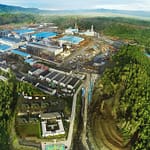
Tsingshan, the stainless steel and nickel giant led by billionaire Xiang Guangda, is the most striking example of this industrial transplant. “When Tsingshan moved into aluminium, everyone was surprised,” said Andy Farida of Fastmarkets. “They are clearly diversifying.” The company’s joint venture with Huafon Group — Huaqing Aluminium — has already commissioned Phase I of its one-million-tonne smelting complex in Sulawesi, with Phase II under construction. A separate Tsingshan-Xinfa venture called Juwan in Weda Bay is ramping to its full capacity of 250,000 tonnes per year, while Taijing in the Indonesia Morowali Industrial Park is expected to begin production in the third quarter of 2026 with output of around 180,000 tonnes.
Tsingshan is also planning a new USD 3 billion smelter — its latest addition to the Indonesian aluminum landscape — with output at Indonesia’s existing and pipeline facilities expected to reach 1.98 million tonnes per year by end of 2026, according to Fastmarkets analysts.
In total, Indonesia has 11 planned smelters totalling 13 million tonnes of capacity, with Chinese companies accounting for approximately 84% of the projects. These are backed by expanding alumina refinery capacity — the projects will need 24 to 25 million metric tons of alumina to support the full build-out.
The strategic logic driving this tsunami of Chinese capital is straightforward. China’s aluminum output is nearing its mandated cap of 45 million tonnes, placing a firm ceiling on domestic growth. This has led Chinese conglomerates to go to Indonesia to develop more primary production which could either be imported back to China or exported to the rest of the world. China is, in the words of one analyst, “borrowing a page from the Japanese investment playbook” of the 1970s — when Japan, facing its own cost pressures, funded the original INALUM smelter in Sumatra and imported the metal for value-added processing at home.
According to projections from Goldman Sachs, Indonesia’s aluminium production is expected to increase fivefold by the end of the decade. “In the next five years, Indonesia will become the focal point of the global aluminium industry,” said Alan Clark, Director at metals consultancy CM Group.
The Investment Case: What Makes Indonesia Irresistible
For investors evaluating Indonesia’s aluminum and bauxite sector, the fundamentals are formidable — and they go beyond the government’s export ban.
Indonesia contains vast bauxite deposits with estimated reserves exceeding 1.2 billion metric tons, concentrated primarily in West Kalimantan, Riau, and Central Sulawesi. The country is estimated to produce up to 37 million tonnes of bauxite ore in 2025, driven by new investments and expanded refining capacity. Indonesian bauxite is prized for its high aluminous content and low impurities, making it a preferred choice for premium aluminum producers.
The labour cost advantage is real. Wage structures in Indonesia are significantly more competitive than in China, which combined with the country’s plentiful coal resources providing affordable power for energy-intensive smelting, has created a cost structure that Chinese investors find almost impossible to replicate domestically.
The government has made the investment environment deliberately hospitable. Fiscal and infrastructure incentives have been introduced to attract investment in new smelting plants, refining units, and logistical infrastructure including port upgrades and rail connectivity. The government has set a target of USD 8 billion in investments for downstream mineral and coal processing, with about USD 4 billion already realized as of August 2025.
And crucially, the timing aligns with a global structural shift. Electric vehicles use about 25–27% more aluminum than traditional vehicles, and automakers utilize about 18% of all aluminum produced globally. As the world’s automotive fleet electrifies, demand for aluminum is structurally rising — and Indonesia sits at the source of the raw material that feeds the entire chain.
The Complication: A Market Creating Its Own Headwinds
The very scale of Indonesia’s ambition introduces a problem that no investment pitch deck tends to feature prominently: the risk of drowning the market in your own success.
Goldman Sachs projects a global aluminum market surplus of 1.5 million tonnes in 2026 and 2 million tonnes in 2027, with Indonesia’s primary production rising from 815,000 tonnes in 2025 to 1.6 million tonnes in 2026. Goldman forecasts aluminum prices falling to USD 2,350 per metric ton in the fourth quarter of 2026. For most smelters, that remains profitable — but the margin of comfort narrows considerably if energy costs or financing costs rise.
The implementation of the 2023 export ban has successfully redirected bauxite from international markets to domestic processing, but the downstream alumina sector’s development has progressed slower than anticipated. Seven major refinery projects face implementation hurdles, primarily due to funding constraints, creating a situation where approved bauxite supply significantly outpaces operational refinery capacity.
And then there is the carbon problem. Aluminum smelting typically demands 13–15 MWh of electricity per tonne of production, making energy security critical. Indonesia’s smelters will heavily rely on coal-fired power — which directly contradicts global efforts to decarbonize the metal supply chain. The European Union’s Carbon Border Adjustment Mechanism, effective from January 2026, levies import charges based on a product’s carbon footprint — meaning Indonesian aluminum powered by coal-fired electricity will face a structural pricing penalty in Europe’s market, even as the EU-Mercosur deal demonstrates how quickly trade architectures can shift.
The Cost Nobody Advertises: What Happens on the Ground
Walk into the exhibition halls of a Jakarta investment forum and you will see slide decks full of production curves, refinery capacities, and export revenue projections. What you will not see — but what is inseparable from the investment case — is what bauxite extraction does to the land, the water, and the people of West Kalimantan.
Bauxite is extracted through open-pit surface mining. The process requires clearing vegetation, removing topsoil across wide areas, and leaving behind a moonscape of red laterite earth and gaping excavations. Between 2009 and 2024, approximately 4,363 hectares of land in Sanggau Regency, West Kalimantan, were converted into mining areas — including 3,318 hectares of primary dryland forest, 289 hectares of secondary swamp forest, and 308 hectares of swamp shrubland.
One mine in West Kalimantan expanded by 2,144 hectares between 2017 and 2023, with around 1,500 of those hectares previously forested. The consequences for communities downstream have been documented in painful detail. In West Kalimantan, bauxite dust has built up on roadsides. Some people, especially children, have developed rashes and boils, which they attribute to heavy metals polluting rivers and streams. Sediment-rich run-off from mines has also raised water levels and increased the severity of floods — with the provincial governor having blamed deadly floods on the numerous mines operating in the catchment.
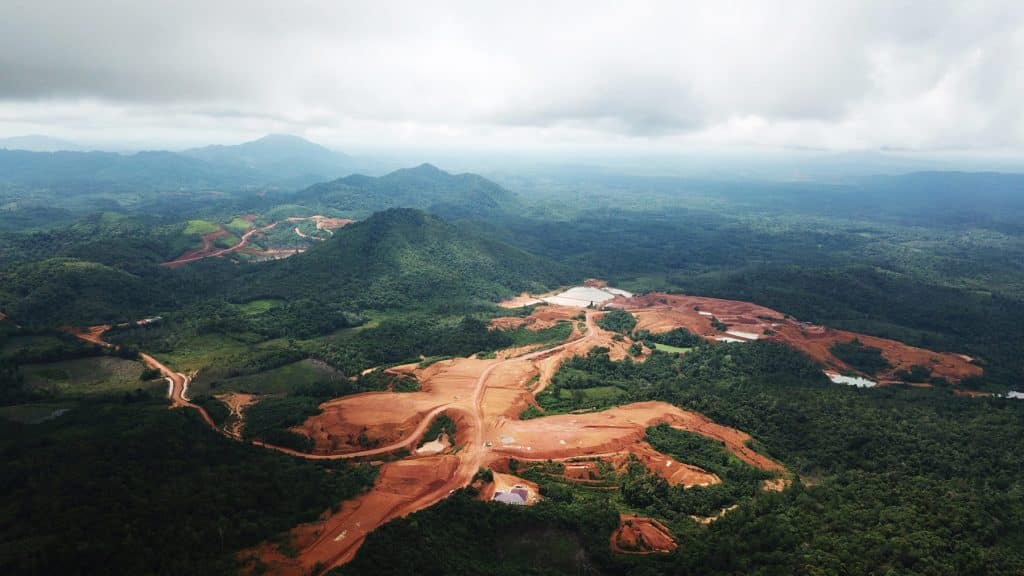
In West Kalimantan, Indonesian children suffer skin conditions attributed to run-off from bauxite mines polluting rivers and streams. Heavy metal pollution from mining waste has begun to be found in river basins used by communities for daily needs, while river sedimentation has increased due to a lack of post-mining reclamation, resulting in declining water quality and damage to aquatic biota habitats.
The ecological impact is highly significant because the open-pit system removes topsoil and natural vegetation, causing severe environmental degradation including loss of forest cover, decreased water quality, and river sedimentation. Environmental monitoring is not functioning as it should, with monitoring reports frequently falling short of regulatory requirements.
This is not a distant, theoretical risk for investors. It is an operational reality that has derailed mining projects in multiple countries, triggered community opposition that halted production, and — in an era of tightening ESG standards — exposed companies and their financial backers to reputational and regulatory liability that can be more expensive than any environmental remediation programme.
The Path Forward: Indonesia’s Defining Choice
The future of Indonesia’s bauxite and aluminum industry appears robust, anchored by growing global demand for aluminum used in everything from automotive body panels to high-speed rail and energy-efficient buildings. The case for investment is real. The government’s downstreaming strategy has proven it can attract capital. The nickel precedent, for all its environmental controversies, did transform Indonesia’s position in global metals markets.
But the aluminum chapter will be written differently from the nickel chapter — or it will repeat its worst features at far greater scale.
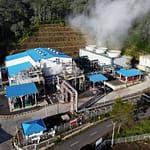
Indonesia’s Net Zero 2060 roadmap commits to renewable energy integration, but practical implementation faces significant infrastructure development requirements. The country’s abundant geothermal resources — which Pertamina Geothermal Energy is already beginning to harness for green hydrogen — could, in principle, power aluminum smelters with genuinely clean electricity. That would solve the CBAM problem, differentiate Indonesian aluminum in European and Japanese markets, and give the sector a long-term competitive advantage that coal-fired production can never provide.
By integrating environmental controls with export policy, Indonesia has the potential to provide a blueprint for responsible critical mineral management in Southeast Asia and beyond — with Indonesian bauxite increasingly rated as a “preferred mineral” by global investors when it meets international ESG standards.
The investors who will do best in Indonesia’s aluminum sector over the next decade are not those chasing the cheapest coal-fired tonne today. They are those who understand that the world’s aluminum buyers — from German automakers to Japanese electronics firms to European construction groups operating under CBAM — will increasingly pay a premium for provably clean, provably responsibly sourced metal. And that Indonesia, with its extraordinary natural endowments and its government’s proven willingness to play geopolitical hardball over resource control, is positioned to supply exactly that — if it chooses to.
The lever has been pulled. The smelters are rising. The question now is whether Indonesia builds an aluminum industry the world can be proud to buy from, or one that simply digs faster and dirtier than everyone else. That choice will define the sector — and the communities living beside it — for generations.
Reporting based on sources including Fastmarkets, Argus Media, Goldman Sachs / Mining.com, Shanghai Metal Market (SMM), CRU Group, Aluminum Market Update (Crugroup), Discovery Alert, Jakarta Globe, Indonesia Miner, Chemanalyst, IDNFinancials, Dialogue Earth, Mighty Earth, Greenation Publisher, and ResearchGate.